Posts

Violence in Our Foods

Image
Violence in Our Foods Fresh Fruit, Broken Bodies: Migrant Farmworkers in the United States by Seth M. Holmes is about migrant farmworkers in the United States, particularly those from Latin America on the west coast. Holmes crossed the border with indigenous farmworkers, worked alongside them in the fields, and interviewed farmworkers of every level (admin, crew bosses, pickers, etc). Holmes realizes "that an ethnography of suffering and migration would be incomplete without witnessing firsthand" how these migrants work (Holmes 40). This immersive study is intended to inform American consumers of where their food comes from and the people that provide them with their produce. Holmes does a wonderful job of integrating his findings with studies and a broader perspective, helping us understand how these migrants have come to be in the position they are. Seth Holmes and his Triqui companions in the border desert. Photo courtesy of Seth M. Holmes. In this book, Holmes immerses hi...

Trujillato

Image
Trujillato  "A Border Drawn in Blood" is an episode of Latino USA that first aired on October 6, 2017, then was re-aired on February 17th, 2022. This episode discusses the complicated relationship between Haiti and the Dominican Republic, especially under the rule of Rafael Trujillo. Trujillo was a dictator of Dominican Republic and ordered the Perejil Massacre of 1937, a massacre that the government tried to cover up. I had never heard of this massacre, and I learned a lot about the conflict between these countries, and their version of a border wall. The Dominican Republic wanted to build a wall to keep the Haitians out- for the same reasons that Trump wanted to build a wall on our Mexican border. At this massacre, "Haitian seasonal farm workers and their families... were massacred because they could not pronounce the consonant 'r' in 'perejil'" (Ayuso 1).  Haiti and the Dominican Republic Border From a report from the UN Environmental Program in 2...

The Maya and Their Origins

Image
 The Maya and Their Origins In the translation of The Popol Vuh by Allen J. Christenson, we learn of the origins of humanity as told by Mayan mythology. In the beginning of the book, we focus on Earth before humans came to be. We learn of the family of the Hero Twins, Hunahpu and Xbalanque, and their own antics on Earth. In the second half, we focus on how humanity came to be. Xcumane and Xpiyacoc form humanity, using “water [as] their blood” and “ears of maize [as] their flesh” (Christenson 179). The Hero Twins, Hunahpu and Xbalanque, were born to the daughter of Gathered Blood, a Xibalban Lord by One Hunahpu’s spit. The story of their conception is a unique one, because at the time of conception, One Hunahpu was dead. One Hunahpu and his brother, Seven Hunahpu, had been challenged to a ball game by the Lords of Xibalba and had been tricked into losing. As a result, the two were sacrificed, and One Hunahpu’s head was hung from the tree at the crossroads, creating the Calabash Tree...

La Venta, San Lorenzo, and the Tuxtla Mountains

Image
  The documentary Lost Kingdoms of Central America from the British Broadcasting Corporation (BBC) discusses the various cities of the Olmec, one of the first civilizations in Central America. These cities include San Lorenzo and La Venta, the second of which is discussed in an article by Rebecca Gonzalez Lauck entitled “La Venta.”  In both the article and documentary, the collection of stones is discussed (basalt, limestone, serpentine, etc.). We do not know how the Olmec transported stone to their cities, but we do know that the nearest quarries were very far from them, ranging from “60 kilometers to more than 400 kilometers” (Gonzalez Lauck 12). This intensive process indicates that the cost of using stone would have been costly and likely a show of wealth, especially when it came to serpentine, which was acquired from “Oaxaca, which is on the western coast of Mexico” ( Lost 36:11-36:21). Serpentine tended to be used more as a show of wealth and ceremony rather than an arc...

Tragedy at Ayotzinapa and Tlatelolco

Image
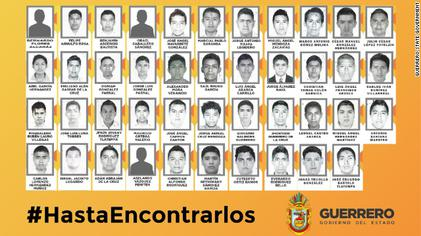
Tragedy at Ayotzinapa and Tlatelolco On September 26, 2014, the world lost 46 young men. 3 of these boys were shot dead by police, and 43 went missing, never to be seen again.  The story of these young men is also the story of the Mexican government failing its people. These young men were students of Ayotzinapa Rural Teacher's College and future educators. The podcast Latino USA discusses this case in its January 28, 2022 episode entitled "After Ayotzinapa: The Missing 43." The 43 Missing Students Ayotzinapa Rural Teacher's College is located in Guerrero, Mexico, a farming town. This school is heavily involved in activism, and its students were planning to travel to Mexico City to participate in a protest for the Tlatelolco Massacre of 1968. However, before they had even begun their protests, they were wounded at the source. As they were commandeering buses to travel to Mexico City (a common practice), local police arrived on the scene and opened fire on the unarmed...

2021

Image
2021  This year was my first year of college. I had a lot of learning experiences- and a lot of homework. Throughout the semester, I read a lot of books for my classes. Throughout the year... not so many.  Bookie's Reading List! : Caligula, marble bust. Artist Unknown. A.D. 37-41 The Metropolitan Museum of Art, New York Barrett, Anthony. Caligula: The Abuse of Power . Routledge, 2019. - In my 8th grade humanities class, we were told never to look up Caligula because of his horrific reign. So, naturally, whenever I see the name Caligula I get interested. I read a couple chapters of this biography before I got busy, and I'd suggest it to anyone looking to annotate a book. The first chapter is filled with complex family trees and wars, so I'd suggest skipping ahead to learn about Caligula's awesome reign of the Roman Empire. Bresnan, Patrick. “Awakening: An Introduction to the History of Eastern Thought.” Amazon , Routledge, 2021, www.amazon.com/Awakening-Introduction-Hist...

Museum Visit: The Edo Period, Art, and Mount Fuji

Image
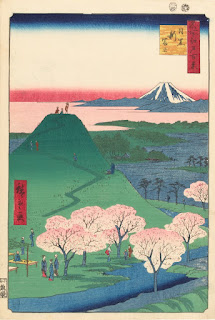
  Museum Visit: The Edo Period, Art, and Mount Fuji I chose to look at the piece New Fuji in Meguro by Utagawa Hiroshige I. This piece was printed in 1857, during the Edo Period. In the Edo period of Japan, art and technology were developing at a rapid pace. This era of domestic growth led to an increased ability to focus on art and nature. During the Edo period, or the Tokugawa period, Japan was very isolated on a global scale. This isolation lasted nearly 250 years, from 1603-1867, as the Tokugawa shogunate worked to prevent western influence within Japan. New Fuji, Meguro  (1857) No. 24 in One Hundred Famous Views of Edo Utagawa Hiroshige Brooklyn Museum      During the Edo Period, Japanese patriotism was encouraged. This meant that Japan was investing in itself- its culture and its people. In art, this patriotism often came in the form of Japan’s beautiful scenery, especially the sacred and beautiful Mount Fuji. This was due to the revitalization of Shinto...