Posts

Tragedy at Ayotzinapa and Tlatelolco

Image
Tragedy at Ayotzinapa and Tlatelolco On September 26, 2014, the world lost 46 young men. 3 of these boys were shot dead by police, and 43 went missing, never to be seen again.  The story of these young men is also the story of the Mexican government failing its people. These young men were students of Ayotzinapa Rural Teacher's College and future educators. The podcast Latino USA discusses this case in its January 28, 2022 episode entitled "After Ayotzinapa: The Missing 43." The 43 Missing Students Ayotzinapa Rural Teacher's College is located in Guerrero, Mexico, a farming town. This school is heavily involved in activism, and its students were planning to travel to Mexico City to participate in a protest for the Tlatelolco Massacre of 1968. However, before they had even begun their protests, they were wounded at the source. As they were commandeering buses to travel to Mexico City (a common practice), local police arrived on the scene and opened fire on the unarmed...

2021

Image
2021  This year was my first year of college. I had a lot of learning experiences- and a lot of homework. Throughout the semester, I read a lot of books for my classes. Throughout the year... not so many.  Bookie's Reading List! : Caligula, marble bust. Artist Unknown. A.D. 37-41 The Metropolitan Museum of Art, New York Barrett, Anthony. Caligula: The Abuse of Power . Routledge, 2019. - In my 8th grade humanities class, we were told never to look up Caligula because of his horrific reign. So, naturally, whenever I see the name Caligula I get interested. I read a couple chapters of this biography before I got busy, and I'd suggest it to anyone looking to annotate a book. The first chapter is filled with complex family trees and wars, so I'd suggest skipping ahead to learn about Caligula's awesome reign of the Roman Empire. Bresnan, Patrick. “Awakening: An Introduction to the History of Eastern Thought.” Amazon , Routledge, 2021, www.amazon.com/Awakening-Introduction-Hist...

Museum Visit: The Edo Period, Art, and Mount Fuji

Image
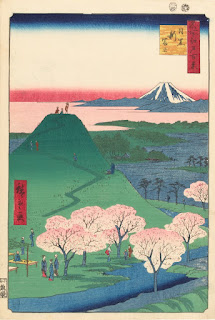
  Museum Visit: The Edo Period, Art, and Mount Fuji I chose to look at the piece New Fuji in Meguro by Utagawa Hiroshige I. This piece was printed in 1857, during the Edo Period. In the Edo period of Japan, art and technology were developing at a rapid pace. This era of domestic growth led to an increased ability to focus on art and nature. During the Edo period, or the Tokugawa period, Japan was very isolated on a global scale. This isolation lasted nearly 250 years, from 1603-1867, as the Tokugawa shogunate worked to prevent western influence within Japan. New Fuji, Meguro  (1857) No. 24 in One Hundred Famous Views of Edo Utagawa Hiroshige Brooklyn Museum      During the Edo Period, Japanese patriotism was encouraged. This meant that Japan was investing in itself- its culture and its people. In art, this patriotism often came in the form of Japan’s beautiful scenery, especially the sacred and beautiful Mount Fuji. This was due to the revitalization of Shinto...

Zen Buddhism's Revolution

Image
Zen Buddhism's Revolution Seated Amitabha, c. 12-13th Century Located in  Tokyo National Museum Buddhism was brought to Japan by Korean and Chinese monks after Korean kings gifted the Japanese emperor a statue of Buddha. The form of Buddhism that was brought over was Pure Land Buddhism, the largest Buddhist sect. Pure Land Buddhism taught that Shakyamuni Buddha was the first of many Buddhas, and he delivered sutras. Buddha Amitabha was an earthly king that gave up his kingdom to become a monk, eventually ruling over the Pure Land of the west- Sukhavati. Buddha Amitabha is one of the most popular Buddhas because his kingdom welcomed “all beings who trusted themselves to him with sincere devotion” (Bresnan 387).  When Buddhism was brought to Japan, it was embraced and integrated into the culture. Shinto and Buddhism affected each other, changing and bringing new ideas to Japanese culture.  When Pure Land Buddhism began to die down, Buddhists monks began to seek out methods ...

China, the Silk Road, and Religion

Image
China, the Silk Road, and Religion T he BBC special, The Silk Road: Where East Met West, focuses on the effects of the Silk Road on China while Patrick Bresnan's Awakening focuses on Buddhism’s influence on Chinese society. The video does discuss Buddhism's journey into China, but it chooses to focus on Islam's impact on western China instead.   The cities of Dunhuang, Turpan, and Khotan are located along the western border of China. These cities were shaped by their location along the Silk Road, one of the most active trade routes in human history. Along this route spread goods like silk and spices, but also ideas like Buddhism and Islam. These cities were heavily influenced by Buddhism, but also Islam, leading to a large population of Uyghur Muslims in these cities. Emin Minaret and Mosque in Turpan           In the city of Khotan, near the western Chinese border, the population is “90% Uyghur” ( The Silk Road 47:45-48:00). This city was the f...

Confucianism, Daoism, and Society

Image
  Confucianism, Daoism, and Society Two of the major schools of thoughts within Chinese culture are Confucianism and Daoism. Confucianism is based on Confucius’ writings that outline “the right social order” (Bresnan 301). He believed the government should “be the leader and protector of the people” and establish order in society” (Bresnan 308). Daoism is an abstract idea, a philosophy that honors the order of nature and seeks to live in harmony with it.  A majority of Chinese society is based on Confucius’ “grand ideal[s]” (Bresnan 301). It began with Confucius’ education system, which ensured that the government would employ people who were capable of running the government he envisioned. This system was “based largely on… the classics of Chinese literature,” as well as etiquette and philosophy (Bresnan 309). Ideally, this education system would be open to all while still preserving social classes. Print of Confucius His philosophy also stretched to relationships- Confucius ...

The Vehicles of Buddhism

Image
The Vehicles of Buddhism Temple containing a branch of Buddha's bodhi tree Chapters 11 and 12 of Patrick Bresnan's work "Awakening" discuss two prominent schools of Buddhist thought- Mahayana and Theravada Buddhism. Theravada means "teachings of the elders," which implies that this path is the more orthodox of the two. Mahayana Buddhism is more spiritual and focuses on making Buddhism more accessible for those who cannot or do not wish to become monks. Mahayana Buddhism is "more influenced by traditional Hindu beliefs and practices," as opposed to Theravada's strict philosophical teachings (Bresnan 262).  Theravada Buddhism originated following the death of Shakyamuni Buddha. Many Buddhists feared the decline of Buddhism due to a splintering of beliefs, because Buddhism was practiced in small, isolated communities during this time. So, theoretically, each of these communities could develop their own practices and interpretations of Buddha's...